
01 / Partial evidence
It cannot see the full production contract.
Historical variants, hidden defaults, background writers, error semantics, and human invariants rarely live in one place.
General-purpose coding agents help you change code. They don't own a live database migration. SSAI's Jumpship agent designs the target, supervises data movement and live sync, verifies the result, and keeps rollback ready through cutover.
Where coding agents stop
A production migration is a changing contract between data, live writers, query behavior, and business rules. A coding agent can produce an artifact. It does not hold operational authority across a multi-day move.
Historical variants, hidden defaults, background writers, error semantics, and human invariants rarely live in one place.
Backfill, CDC, quarantine, independent proof, approvals, cutover, receipts, and rollback still become your project to assemble.
Equal counts can hide changed meaning, broken relationships, ordering drift, target-only rows, and application regressions.
You can copy every row and still migrate the business incorrectly.
Where Jumpship takes over
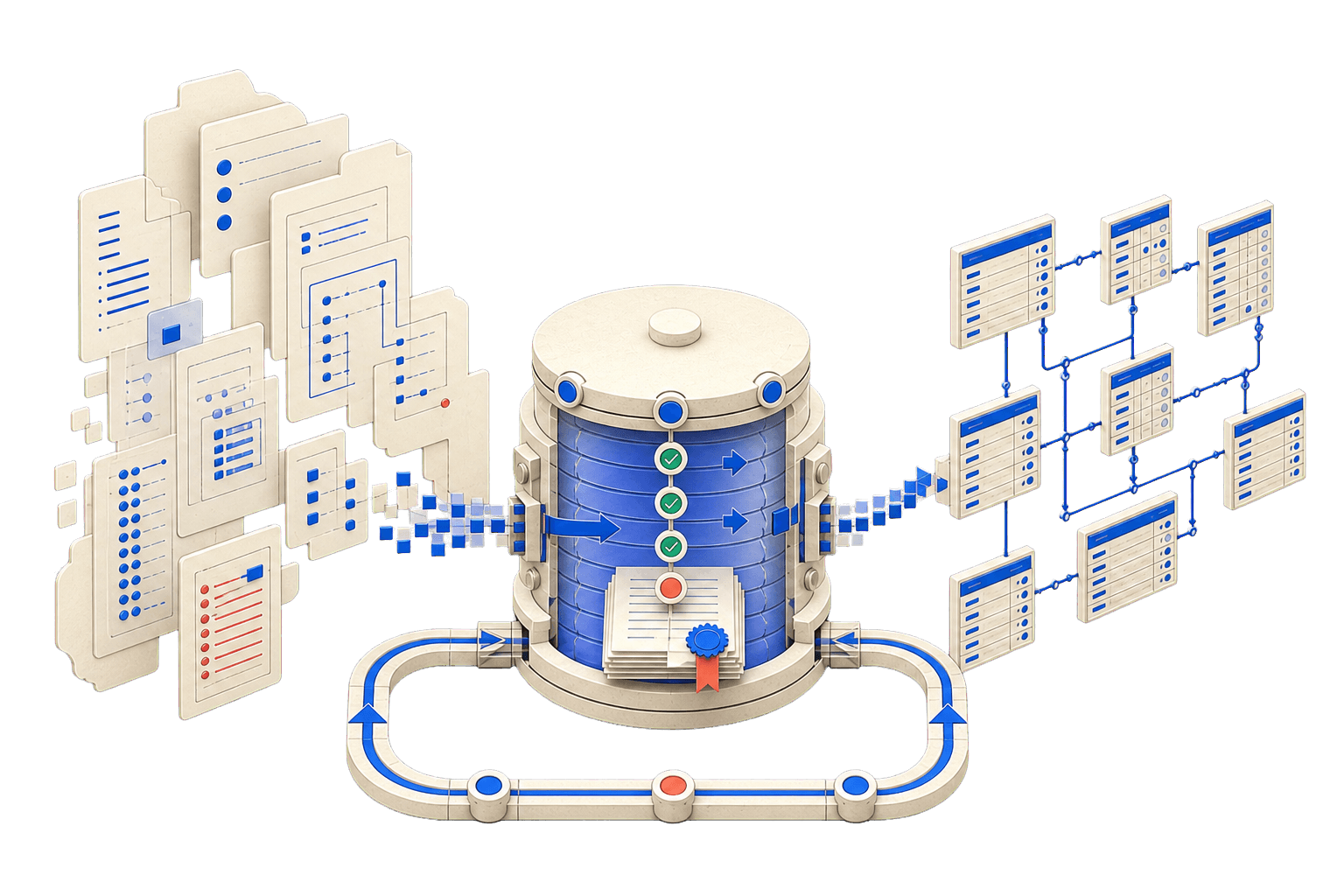
Jumpship keeps one accountable trajectory from first evidence through decommission, while deterministic machinery performs every record effect.
Evidence, variants, invariants, unknowns, decisions, and undo boundaries stay attached as the migration changes over time.
The model investigates and specifies. One compiled transform drives baseline and CDC, with typed quarantine and durable receipts.
Independent verification gates the rehearsed cutover, while a qualified reverse path remains visible, current, and operable.
The cost of assembling it yourself
Compare an assembled migration project with a purpose-built system. Change the planning assumptions to see where customer time goes.
4 engineers × 20 migration hours/week × 18 weeks
2 reviewers × 8 hours/week × 8-week illustrative target
Illustrative planning model, not a quote, benchmark, or delivery promise. Source condition, volume, document variation, writers, connectivity, and review latency can materially change the plan. SSAI pricing is set after migration review, so the final percentage is labor-cost reduction or budget headroom before the SSAI fee—not total engagement savings.
Every database pair is a different flight plan
MongoDB Atlas to customer-owned Supabase PostgreSQL is the launch corridor. The other pairs below illustrate future qualification targets, not currently available support.
Pair 01 / 72 · every ordered cross-database pair is visible.
Questions worth asking
Guarantees, custody, AI scrutiny, economics, and rollback should be inspectable before you trust the migration.
SSAI does not make a blanket zero-downtime or perfect-schema promise. It declares the guarantee tier for your environment, then binds cutover to a versioned mapping, a rehearsed runbook, independent five-layer verification, a signed evidence root, and fresh named-approver consent. If a precondition cannot be proven, Jumpship blocks, downgrades the tier before consent, or declines.
Migration review
Currently onboarding MongoDB Atlas to Supabase PostgreSQL migrations.
Request a migration review reason